Saturday, March 17, 2012

Historical Fragments #3: Notes for "26 Missions."


Historical Fragments #3:
Notes for “26 Missions”

by

Wally Lee Parker
(member: Clayton/Deer Park Historical Society)

(all rights to this material retained by author)
  

… initial thoughts …

            Currently I’m trying to put together a story about one of Deer Park, Washington’s, WWII veterans, Staff Sergeant Robert Willis Grove — Enlisted Bombardier / Armorer / Left Waist Gunner — 407th Bombardment Squadron, 92nd Bomb Group (Heavy), 8th Army Air Force.  One piece of this story will involve the several well-known tail damage photographs reproduced here.  Among the other pieces comprising the completed story will be an outline of the Grove family’s long history within the Deer Park community and Willis Grove’s twenty-five other B-17 missions over wartime Europe.


Tail damage to B-17E #41-9020.
Army Signal Corps photo taken on October 5, 1942, at Bovingdon Airfield, England.
(Photo courtesy of Gordon Grove.)

            I suppose the Willis Grove story could be sketched without any detailed exposition — meaning without discussing anything requiring in-depth research.  And that would be easiest.  Willis passed away some time ago, so I can’t ask him to tell his own story and then just transpose that into script.  His absence from the project means I don’t have his words to direct me toward what I need to know in order to stitch this story together.  So as noted, I could just lay out the several remarkable wartime photos his son, Gordon, sent me as a photo essay without looking any deeper.   But I think there’s something unique about this soldier’s story that needs to be told — something unique that only further research can reveal.


From left to right: Lt. James C. Dempsey Jr. — pilot; Lt. James B. Foster — co-pilot; Staff Sergeant Robert W. Grove — bombardier; Corporal Sidney Hardaway — flight engineer/top turret gunner; PFC Stanly W. Brooks — assistant engineer/gunner; Corporal R. B. Sandlin — radio operator; Tech Sergeant John Paulick — assistant radio operator/gunner; Sergeant J. M. Kirk — rear gunner.  Not shown, Lt. W. D. Toole — navigator.  (Though officially rated as a enlisted bombardier — MOS # 509 — it’s likely Staff Sergeant Grove’s position on this flight was that of gunner since the 8th Air Force’s official policy was that only commissioned officers could fly as bombardiers.)
(Photo courtesy of Gordon Grove.)

            Willis Grove represents a generation of teenage and barely older boys who went off to war and by-in-large came home to live quiet lives, seldom saying much of anything about what they personally did or how they personally felt about the war.  It’s only been in the last quarter century, as their numbers have noticeably dwindled, that the soldiers of World War II have begun to show that literally none of them came away from combat without to some degree being torn.  When they do talk — in those moments when their eyes glisten and maybe a drop or two of tear rolls free — it seems most of the pain recalled isn’t for the harm done to them personally by either circumstance or the enemy.  Rather the tears are for those dimly recalled friends left behind almost seven decades ago — those dimly recalled faces destined to never age.
            From the summer of 1942 until the summer of 1943 Willis Grove was caught up as part of the largest air armada the world has ever seen.  He was taking part in an aerial campaign of scorched earth as first envisioned in the waning days of World War I by Winston Churchill, among others.  He was taking part in what, at that time, was very much an experiment that no one was sure would work.  He was very much part of an experiment in calculated attrition.
            The story that needs to be told here involves fear and the will to overcome it.  After all, the one thing these boys quickly developed was an appreciation for the amount of jeopardy doing their duty placed them in.  That’s very much a part of this story — the fact that these young kids, despite knowing the risk, went into the air again and again and again.
            The object now is to start gathering the parts for this story.  At some point the various parts will begin to find and settle into their own place.  And then, hopefully, we’ll discover that the story has written itself.  

… our windows began to frost up …

            These are the words of Lt. Eugene Wiley, pilot, regarding the mid-air collision of his B-17 with a B-17 flown by Lt. James Dempsey Jr. during the early part of the 8th Air Force’s October 5th, 1942, mission to Lille, France — what was to have been Willis Grove’s first combat mission.
            “As we climbed out over the North Sea into the sun, our windows began to frost up, the silica gel from the old E’s needed replacing and it was not doing the job of removing the moisture in the windows.  The sun and frost made it extremely difficult to see.”
            Thought visibility was only one of the factors in the collision, from the first hand reports on the incident it’s apparent that visibility did contribute.  And that contribution has drawn up a set of research questions regarding the windscreens on the B-17s.
            The following is a background description of part of that visibility problem.  Since the paragraphs below are just an attempt to lay out the essential facts, the words used in the actual article are likely to be significantly altered during the many rewrites yet to come.

            The windows on the B-17 bomber were glazed with two types of material — laminated glass and clear plastic.  Discovered in the late 1870s, and first produced as large, visually clear sheets in the 1930’s, acrylic (aka polymethyl-methacrylate or PMMA) was the substance of choice for the complex curves of the B-17’s “greenhouse” nose.  As for the craft’s glass windscreens, those were composed of two sheets of glass bonded together by thin films of clear, tough, flexible plastic — the same type of lamination process used in today’s automobile windshields.  Though the lamination process did increase the windscreens’ resistance to impact, more importantly any glass shards produced by a broken window tended to adhere to the bonding plastic rather than spraying throughout the aircraft’s interior — and the laminated glass, even if essentially shattered, could still remain intact enough to deflect the onrushing airstream.
            The primary function of the various windscreens was exactly that — allowing visibility while shielding the crew from a pristine airstream that could, at altitude, reach temperatures of minus 50º Fahrenheit or more, and — by adding the effect of wind-chill to such frigid air — produced a heat eroding cold that could freeze bare flesh in seconds.
            During the combat phase of missions, the airstream was far from pristine.  Often filled with energetically propelled bullets and flack, it also contained a metallic grit of sorts; grit composted of spent munitions falling toward the ground with, on occasion, pieces torn from other aircraft mixed in.  While some of the B-17’s windscreens — such as the tail gunner’s aft-looking sighting window — were extra thick, none were expected to deflect a still potent bullet hitting straight on.  However, against smaller metal fragments dropping through the sky solely under the influence of gravity, laminated glass could provide the crew of an onrushing aircraft at least some protection.
            Certain B-17 windscreens were double-glazed as an anti-frost measure.  Reportedly the pilot and co-pilot’s forward facing windscreens, the cabin’s sliding side-windows, and the pie-shaped, flat laminated glass bombardier’s segment of the otherwise acrylic nose of the bomber were all double glazed — meaning two panes of laminated glass separated by a dead-air space.  The sighting windows for the turret, ball, and tail gunner were also anti-frost.
            The bombers did have a cabin heating system.  Glycol (in this case a 55/45% mixture of diethylene glycol and ethylene glycol), pumped through a metal coil in the exhaust stack of the left wing’s inner engine — engine #2 — was heated by the glowing combustion gases (reportedly the area of the exhaust stack in which the coil was situated could reach up to 1600ºF).  The glycol was fed through a duct-enclosed radiator mounted inside the left wing close to the fuselage.  Fresh air drawn from an extraction port in the #2 engine’s intercooler intake was routed through the ductwork.  When passing through the radiator the air was heated.  The heated air was then vented into the aircraft’s heating system.
            Ductwork inside the floor of the fuselage diverted a portion of the incoming heated air to vents opening under the pilot and co-pilot’s windscreens, and to the bombardier’s sighting windscreen.  As for effectiveness, one former B-17 crewman reported that those were the most effective of the aircrafts heating vents, stating that more than once he’d noted the cabin’s unheated side-window covered with “hoarfrost,” while the pilots and bombardier’s windows were clear.
            Then of course there were the windshield wipers — one would assume only useful for clearing mist or rain from the windscreen while sitting or taxiing.
            But Lieutenant Wiley’s description of the visibility problem specifically included the phrase, “the silica gel from the old E’s needed replacing and it was not doing the job of removing the moisture in the windows.”
            When Lieutenant Wiley described the “moisture in the windows,” he’s referring to a specific problem mention on page 375 of 1942’s “Technical Order Number 01-20EF-2,” — also known by the more explanatory title, “B-17 Erection and Maintenance Instructions.”
            Under the heading “assembly and installation” of “windows,” one paragraph states, “The dehydrator unit is designed to assure complete absence of moisture in the air or gas trapped between the panels and the success of the defroster equipment depends upon the maintenance of a dry air condition.”
            What’s being referenced is the dead-air space trapped between the double-panes of the aircraft’s anti-frost windscreens.
            It’s likely that the glass panels of the double glazed windscreens were held separate by a rubber gasket, and then sealed into their frames with some type of calking.  The necessity of using a “dehydrator unit” as noted above suggests that air-tightness — in the sense of an absence of leakage — was not an expectation for the windscreens.  Climbing would raise the pressure of the desiccated air trapped between the double panes relative to the lower pressure of the outside air.  It’s likely the extreme cold found at altitude would both shrink and reduce the flexibility of the calking materials — speeding the outward leakage of the trapped and now relatively pressurized air.   Once air had leaked out of the dead-air space, the increasing atmospheric pressure of descending flight would have pushed moist outside air back into the now reduced pressure within the dead-air space.
            The dehydration unit was a visually clear, cellulosic plastic (aka Tenite) cylinder about one inch thick and ten inches long.  The otherwise closed cylinder had a nipple fixed to one end so a length of rubber tubing could be attached.  The cylinder was attached to the aircraft near the window it was intended to service, and the free end of the rubber tubing was connected to a fitting on the intended window.  Once attached, the air in the dead-air space could circulate through the granular silica desiccant contained in the cylinder — the cylinder being what was referred to in the maintenance material as the dehydration unit.
            As for how Wiley knew “the silica gel from the old E’s needed replacing” — other than the fact that “the windows began to frost up” — it was obvious from the color.
            Despite being called a gel, silicon dioxide is a granular solid.  It likely retains that name from the gel state it passes through during manufacture.  The granules are colorless — in this case meaning white.  To visually signal the presence of moisture, cobalt chloride is added to the gel.  As the maintenance manual explains, the “presence of moisture in the dehydrating compound is indicated by a change in color from normal dark blue or dry condition to a white or light pink.
            The manual goes on to say, “The silica gel crystals may be restored for re-use by baking at a temperature of 149ºC (300ºF) for 4 hours, or until all crystals regain their dark blue color.  Discard cartridges or replace with new silica gel crystals after 20 reactivations.”
            And finally the manual promises, “These precautions, when properly followed, will relieve any condition of fogged or frosted windows.”

… and yet to come …

            If all goes well, you’ll begin to see this story condense over the coming summer.  At some point you’ll have enough data to understand the story’s background, and I’ll have enough data to begin laying all these notes out as one linear script.  We’ll see.

— As always, comments and corrections are welcomed. —

Monday, March 12, 2012

Historical Fragments #2: More Mr. Brook.


Historical Fragments #2:
More regarding Washington Brick & Lime’s Mr. Brook.

by

Wally Lee Parker
(Member: Clayton/Deer Park Historical Society)

            History is very much a mess.  When history is presented as one clean, seamless, unambiguous stream of high definition facts, images, and deductions, the writer of said history has either done an exceptionally detailed job of research, or the writer has swept all the messy, not quite fitting bits up into one tidy pile and nudged them neatly under the rug.  Look closely at the pattern lining the floor of most any beautifully concise historical set piece and you’re likely to see the lumps.  That’s just the way history works.
            On the other hand, it’s all those little unfitted bits that keep historians employed — or, as in the case of us unpaid amateur volunteers, engaged.  Each of these ignored bits, once understood well enough to be fitted into the overall puzzle, has the potential of significantly revising things that most everyone had previously agreed upon. 
            As for coming to an agreement in the first place, a number of questions about our incoming data were left unresolved from the last “Fragments” — that particular article having been spent rummaging around the few known facts about the life of Washington Brick & Lime’s co-founder, Henry Brook.  Since that article was first posted, a few new questions have been added to the unresolved jumble.

Photo courtesy of Randy Holman
Descendant of Henry & Kezia Brook
            Regarding the names of Henry Brook’s daughters, some progress has been made.  A page from the Spokane Falls City Directory has surfaced listing Miss Annie M, Miss Helen, Miss Kate W. and Miss Lottie W. — all stated as living at 706 5th Ave.  The directory was printed sometime between 1890 and 1896.  The date of publication obviously needs to be pulled down tighter.
            My suspicion is that nicknames were often used when referring to these daughters – and nicknames for young debutants apparently tend to change as the girls’ age.  Such changes, along with typesetter’s errors, might help explain the several disparate first names found in the newspapers.  But there’s also the fact that simply living at the same residence doesn’t mean all the girls being referred to as “Miss Brook” in the city directory had to be siblings.  Some could be Henry’s nieces or even his unmarried sisters — if there were any such — though at this point I’m going to assume that’s not the case.  At this point we just don’t know for certain.  I’m casting some doubt because, as cautioned in the first “Fragments”, making assumptions to bridge these gaps in our knowledge has a way of coming back to haunt.
            What we do know is that Henry had five daughters, so at least one daughter is missing from the city directory’s list.  We also know one of his daughters drowned at a young or relatively young age.  But if we assumed the drowned daughter is the one missing from the city directory, we’d be wrong.
            An article — part of which is reproduced below — appeared in the July 19, 1899 issue of The Chronicle.
            “It will be a sad party which will arrive here this evening on the Northern Pacific from Rathdrum bringing the bodies of Misses Charlotte W. Brook and Marion S. Porter, two popular young ladies of this city, who were drowned yesterday afternoon while boat riding on Spirit Lake.
            “The two young ladies had been at Spirit Lake since the Fourth of July.  Yesterday afternoon they, in company with Miss Hattie McCallum and Messrs. Fred Chamberland and J. H. Moseley, all of this city, were out on the lake in a small row boat … 100 yards from the shore it capsized, throwing the occupants into the water …
            “ … In a short time after the accident the bodies of the two young ladies were recovered by divers, and every effort was made to resuscitate them, but to no avail, life being extinct.
            “Both of the young ladies were well known in this city, and had a wide circle of friends.  Miss Brook, who was familiarly known as Lottie by her friends, is a daughter of Henry Brook, president of the Washington Brick and Lime Company, and she has lived in this city for the past 18 years, having come here with her parents when she was but three years old.”
            So now we know that “Lottie” was actually “Charlotte W. Brook.”
            As for the other girls, looking in “The Illustrated History of Spokane County,” published in 1900, we find “Kate W. Brook” being married to W. S. McCrea — William Stone McCrea — in 1895.  We know from later articles that her first name was actually “Katharine.” 
            Two of the four directory names now seem accounted for.
            Another “Brook” son-in-law — Mark F. Mendenhall — was married to “Harriet Helen.”  That accounts for “Miss Helen.”
            Now we’re down to one in the Spokane Falls City Directory — Annie M. Brook.
            Backtracking for a moment, it appears we can also account for the one daughter unnamed in the city directory — the fifth daughter.  In “The Illustrated History of Spokane County” we find that son-in-law James E. Daniels’ wife was Mary E. — clearly stated as being the daughter of Henry and Kezia Brook.  The two, Mary and James, were married June 3, 1890 — and apparently (because of her absence from the city directory) the first of Henry’s daughters to marry.
            That leaves one daughter — listed in the directory as Annie M. — and one son-in-law, J. M. Moore.  And it seems reasonable to at least tentatively associate the two.
            So, this is the ‘tentative’ layout of Henry Brook’s family — not of necessity listed in order as far as the ages of the daughters are concerned:
            Henry Brook & wife Kezia Letch-Brook.
            Mary E. Brook & husband James E. Daniels.
            Katharine (Kate) W. Brook & husband, William Stone McCrea.
            Harriet Helen Brook & husband Mark F. Mendenhall.
            Annie M. Brook & husband Joseph. M. Moore?
            And finally, Miss Charlotte W. Brook.
            But when it comes to residents of the Clayton/Deer Park area, there’s likely to be a bit of confusion in all this — confusion regarding J. M. Moore and his (perhaps) wife Annie M. Brook.
             It seems J. M. Moore was a prominent name in pioneer Deer Park.  Page 571 of the Reverend Jonathan Edwards’ “An Illustrated History of Spokane County, State of Washington” — the 1900 edition — states that “J. M. Moore … born in Tazewell County, Virginia, in 1860 … came to Spokane County (in 1888), located at Deer Park and engaged in the lumber business.  He is now proprietor of the only hotel in Deer Park.”  Further on the article says, “He was married in 1886 to Alice Grimes, a native of Virginia …”
            Knowing something of the history of Joseph M. Moore when he resided in Spokane, it seems fairly apparent that we’re talking about two different men.
            And as one last puzzle regarding the family of Henry Brook, below is his biographical data as printed in “The History of the Pacific Northwest, Oregon & Washington, Volume II.” This tome was published in 1889.
            “The record of this gentleman is not only a satisfactory commentary upon his own business capacity, but also upon the dimensions of the business of the city, and a scale of its enterprises, since his coming here in 1883.
            “Mr. Brook was born in England in 1842, and came to America in 1870, locating at Minneapolis. He reached Spokane Falls in 1883, doing since that time a very successful business. In 1885 he was elected a member of the city council, and while in that office favored the measure to buy the waterworks and furnish the people water at cheap rates. He is no less enthusiastic than his neighbors in his confidence in that city. He is married and has a family of six children.”
            The last bit of data — assuming it’s not an error — says Henry has six children.  We have his five daughters listed above.  Assuming the article in the “History of the Pacific Northwest,” is not in error, where is this sixth child?
             Perhaps he’s at Spokane’s Fairmount Memorial Park.
            Going back to a 1954 Spokane Daily Chronicle article about one of Henry and Kezia’s daughters, Katharine McCrea, the newspaper reported that “Katharine Brook came west from Minnesota with her parents and brothers and sisters.”  Add that to an internet listing of graves found a Fairmount Memorial Park — graves that appear to be in close proximity to each other – and we may have just found that sixth child.
            The names of interest are Henry Brook, age 65; Kezia Brook, age 62; Lottie Brook, age 21; and Harry Brook, age 4.  The source for these names state that they were copied directly from the cemetery’s records.  To make certain this is a family grouping, it will be necessary to visit the park and look at the stones.  I’m adding that to my ‘to do’ list.
            The problem here is that we have no date for Harry Brook’s death.  Six children are mentioned in the 1889 “History of the Pacific Northwest” book.  “Brothers” are mentioned as having arrived in Spokane Falls with the family in the 1954 article.  And Harry is listed as being 4 years old at the time of his death.  If Harry was the sixth child, and if he was with the arriving family in September of 1883, his death would need to have occurred no later than 1887 for all of these factors to mesh together.  Of course the biographical data in the 1889 book could have been several years or more old at the time of publication.  But still, it’s a puzzle.  That and the plural form of “brothers” used in the 1954 article.
            And lastly, there’s this bit of unique data scoured from the internet.  It appears as part of a family history file regarding one George Theodore Belden, born in Rome, Ohio, in 1840 — and apparently an acquaintance of our Henry Brook.  The history file was posted on one the larger genealogy sites.  The material itself is stated as having been extracted from handwritten materials, possibly journals, letters and the like.  Since copyright may be involve, and since my attempts to contact the players responsible for posting the material have so far proven fruitless, I’ll paraphrase as much as possible when using the material in question.
            During the winter of 1882-’83, Mr. Belden — at that time residing in Hutchinson, Minnesota — came into possession of two publications, an unnamed “west coast magazine” and “a chronicle” (the Spokane Falls Chronicle was published between 1881 and 1890, and is therefore likely the “chronicle” meant).  Those publications contained “write-ups” about “Spokane Falls” and the “Inland Empire.”  In March of 1883 Mr. Belden, “in company with the late Henry Brook and a few others,” struck out for the Washington Territory.  According to the family file, the journey began on a stagecoach pushing through “huge snow drifts.”  The record as presented on the website seems disjointed and incomplete — as is likely the source material.  It indicates the second night was spent “snow bound in Iowa.”  If the time scale is correct, and considering the distances involved, our assumption would be that somewhere between Hutchinson, Minnesota and the boundary into Iowa, the group boarded a railroad train, and that it was the train that was snowbound in Iowa.
            Regardless, the narrative goes on to say from Iowa the group followed “the southern route to San Francisco.”  Other sources indicate that a portion of the northern transcontinental railroad route through Montana’s Rocky Mountains to Spokane wasn’t completed until early 1883.  Those sources also noted that said transcontinental route wasn’t open for regular travel until September of that year — 1883.  The Belden material indicates the Belden/Brook party continued on from San Francisco to Portland — apparently arriving in Portland on “March 28.”
            As an indicator of the time on the road, the material says “the three weeks travelers rolled into Spokane,” — leaving the impression that it was likely at the very tail end of March when Belden and Brook stepped off the train in Spokane.
            As for what Brooks did in Spokane, this quote.  “Mr. Belden bought half a block where the first gas works was afterwards located.  (-----), there Mr. Brook & himself built their first houses.”
            It seems evident that the families weren’t with the men on their early spring arrival in Spokane because the material goes on to indicate that “Mr. Belden” then returned “over the Rockies by four horse stage” to Minnesota, to retrieve “the two families” — assumedly those families being his and Henry Brook’s.
            As a final note relevant to Henry Brook, the above material states, “The families came in September on one of the first trains, meeting Gen. Grant and other notables who had attended the driving of the last spike.”
            The Saturday, September 8, 1883 issue of the Spokane Falls Review detailed the preparations that had been made for that day’s celebration of the completion of the transcontinental route through Spokane Falls.  The next Saturday’s Spokane Falls Review — the one published on September 15 —detailed everything that had gone wrong.  But it also mentioned that General Grant — and all indications make it clear that they meant General Ulysses S. Grant, former President of the United States — was with the prior Saturday’s visiting party of dignitaries.  The Spokane Falls Review finished its article — headlined “Somewhat Short / The Intentions Were Good, But the Execution Prevented” — by saying, “The spike was not driven until a late hour Saturday, and the trains were behind hand at every point on the route.  We wish it had been otherwise, but as it was not, do no not propose to kick and find fault,” — this last quote’s wording — apparent typos and all — is exactly as seen in the paper.
            The above would suggest that it was indeed September 8th when the “two families” arrived in Spokane.
            As noted, I would hope that someday we could provide details as to the circumstance of how the quoted Belden family file was collected — details as to the authors, and perhaps even photo-reproduction of the original handwritten pages from which the above notations were extracted.  That at least would be my hope. 

Tuesday, February 14, 2012

Skating Through Valentine's Day


Skating Through Valentine’s Day

by

Wally Lee Parker

            This year I’ve figured out how to skate through Valentine’s Day.  Anne Rice’s newest novel arrives at Barnes & Nobel’s today.  This book, “The Wolf Gift,” is a return to her darker, urban fantasy side.  And it’s her first story about werewolves.  So I reckon a copy of that should keep me out of trouble with the wife.  Sort of like a Valentine’s Day card with fangs.
            I’m not at all the sentimental type you understand - though I’ll begrudgingly admit that “Valentine’s Day” is on my list of favorite movies.  (Not nearly as high up the list as “Sleepless in Seattle,” “Love Actually,” or “High Plains Drifter,” but still pretty high.)  I thought Jennifer Garner’s encounter with a heart shaped piñata was an especially meaningful bit of thematic drama.  And every scene with Jessica Beal in it was exceptional – which suggests I find cool competence (when not reduced to a blubbering, chocolate craving mess – and sometimes even then) a very attractive trait in women.  And I’ll also admit that I did suffer a bit from that pesky recurrent dry-eye syndrome when Julia Roberts finally got home to her ‘man.’  In truth I think my tendency to tear up really has more to do with the synthetic-butter vapors rising off those giant tubs of popcorn than anything happening on the screen.  That’s my hypothesis anyway - and I sticking to it.
            I even liked parts of “I Hate Valentine’s Day.”  Mostly the parts where Nia Vardalos was front and center - since she’s usually the best thing about her movies.  And I’ve watched “Letters to Juliet” half a dozen times.  But that really doesn’t mean anything – and it certainly doesn’t mean I have a sentimental streak.  In Juliet’s case I just liked seeing the Italian scenery in Blu-ray.
            But all this makes me wonder.  Do kids learn discretion from watching their dad weep at the movies?  Do kids learn that there are some things we just don’t talk about from watching pop turn away and dab his eyes when Sally and Tom finally get together, finally entwine their fingers while standing face to face on top of the Empire State building?
            I suspect it could be.
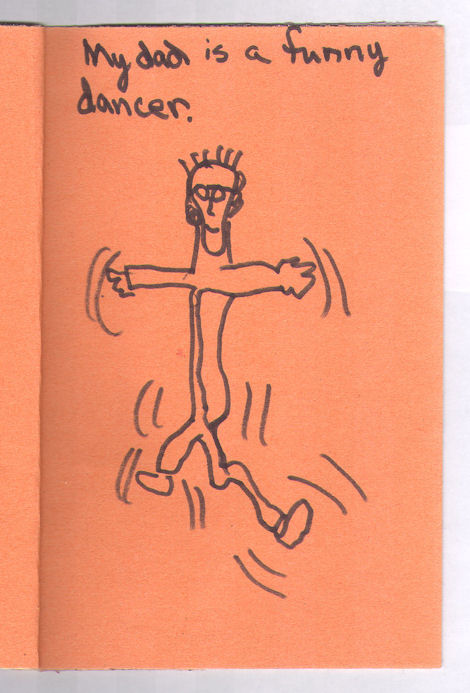
            So this Valentine’s Day, with thanks for not letting the cat out of the bag all these years, I’m going to send a Valentine’s card out to my kids.  It’s just the images from a booklet my daughter put together for Father’s Day about 25 years ago.  I have boxes of this stuff from both the kids.  Not that I intended to keep any of it you understand.  I just haven’t got around to throwing it out yet.
            My daughter reminds me a lot of Jessica Beal.  If there’s any meanness in her, I’ve not seen a trace.  She’s emotionally graceful and without a thread of ostentatiousness.  She possesses a strategic intellect – meaning she can plan things out years in advance and actually end up where she intended.  And she seems comfortable with herself – which is the best any parent can hope for.
            As for the boy, Technical Sergeant Parker, Washington Air National Guard – I don’t think he has ever understood why his dad suffers a whiff of that dry-eye syndrome whenever he shows up in his class-A uniform.  Maybe it has something to do with the realization that all those things I admired about my own dad – all those special qualities that seemed to have passed me by – somehow magically found their way into him.  Maybe that’s the reason.
            Not that I’m being sentimental about any of this you understand.  It’s Valentine’s Day.  It’s an obligation.  And it’s this damn dry-eye syndrome.


Thursday, February 9, 2012

Working in the Fruit: 1935 - 1940s.


Working in the Fruit
1935 — 1940s

by

Wally Lee Parker

(Reprint from the Enkey-Parker Family History Newsletter.)

(all rights reserved)


            Transcribed from tape recorded interviews, these stories, told by my mother, Lillie Ada Enkey-Parker, and uncle, James (Jim) Grady Parker, recall the migrations of the Parker clan as they followed California’s seasonal agricultural work.  The time period involved begins in the latter part of 1935 and continuing into the war years.  Other family members mentioned include my dad, Owen Lee Parker, grandfather, Alfred Wallace Parker, uncles Ethmer and Sam Parker, and Wanda and Faril — two of my three sisters,
            Our best guess for the first set of stories is about 1935 or ‘36.

            Jim: “I can’t remember but this one time that Owen and Lillie was with us when we picked apricots.  We had been picking cherries at Beaumont, that’s on the road between Los Angeles and Palm Springs.  When the Cherries was done we drove south a few miles, over some mountains, to the town of Hemet.
            “The women was working in the sheds.  So I guess me, Owen, Ethmer, and Dad was the only pickers they had in the orchard.  We could keep enough apricots picked to keep the sheds going anyway.
            “They had a bunch in the sheds.  Women and kids — kids who was big enough to work.  They was cutting apricots in two, taking out the seeds, and laying the halves out on drying trays.”
            Lillie: “The men would pack the lugs of apricots into the sheds and set them down close by.  We’d take our knife and cut down to the apricot pit, then spin the apricot into halves.  You’d use two fingers to pull the pit out and throw it.  Then arrange the apricot halves on this wire screen stretched ‘cross a wooden frame.  When you got the frame covered with apricots, the men would pick it up and carry it to the drying shed.
            “Quick as your box got empty, the boys would bring another lug.”
            Jim: “They had drying sheds for the apricots.  Air dry — sun dry.  We’d take those trays, some four foot by eight foot, some two foot by eight foot, and stack ‘em, row after row.  They’d end up with maybe a couple of acres of them trays stacked.  Then they’d fumigate them.  Seems like they used sulfur of some sort — burnt the stuff — to fumigate the apricots and keep the bugs off.”
            Lillie: “I’d take Wanda into the shed with me.  The people put up one of them jumper swings right next to where I stood.  In that swing Wanda could hit her feet on the floor and swing, and I could keep her pacified while I worked.
            “I don’t remember how they paid us in the shed — it might have been piece work — keeping count of the trays we covered.”
            Jim: “Out in the orchard one day, we heard Dad (Alfred Wallace Parker) holler.  ‘You boys get over here!’  So we started walking toward his voice.  In a minute he hollered again — this time mad.  ‘Quit piddling along!’  We couldn’t see him, but he could see us.  So we took to running.
            “He was hanging in one of them little apricot trees, his arms and legs wrapped around a limb.  Hanging up there just like a possum, with his ladder lying on the ground under.  ‘You boys get me down!’  We didn’t laugh loud ‘nough he could hear us.  But that was the funniest thing.”
            Lillie: “When it come to cherries, we used what was called cherry buckets.  You snapped the bucket on, then when you come out of the tree you could unsnap the bucket to pour your cherries into the box. 
            “When I worked in the packing sheds we had a special way of boxing cherries.  The first layer at the bottom of the box you laid in real careful — a nice flat layer with all the stems turned one way.  Same with the second layer.  After that you just piled the cherries in.  Then they boxed up the cherries — put the lids on the boxes.  But the lids they nailed on were really the bottoms of the boxes, so when whoever bought the box opened the top, there lay all them cherries in pretty rows. 
            “We worked in the prunes too.  I could do good in prunes.  You just spread a couple of big tarps under the tree.  Using long poles with hooks on the end, we’d hook a limb and shake.  The prunes would fall on the tarps.  We’d just pick them up and lug ‘em.  It was messy work when the prunes was ripe.
            “We’d take bottles, diapers, whatever, out into the orchards with us.  We’d take an apple box to set Wanda in.  After Faril came along we did the same with her.”
            Jim: “I’m thinking it must have been about 1937 — the year Faril was born.  We was picking Apricots at Hollister — about twenty or thirty miles inland from Monterey Bay.  We was working for this contractor.  He was paying a nickel a bucket.
            “This old boy use to be a boxer — a sparring partner for one of the heavyweights.  He showed it too.  His nose was pushed flat across his face.  And his hands — one hand was ‘bout as wide as both of mine.
            “When picking, you’d fill a couple of buckets, then take them to the contractor.  Each worker had a punch card, and the contractor would punch it for each bucket you brought in.  That’s how you got paid at the end of the day.
            “So Sam (Vernon “Sam” Del Parker) comes down with a couple of buckets.  The guy looks at them and says, ‘Sam, I told you and told you not to pick them green apricots.  You’re getting them too green.  And you go right out there and do it again.  So I ain’t gonna pay you for these.’
            “Sam says, ‘Yes you are!’
            Sam was a hot headed little devil anyway.
            “No Sam, I ain’t gonna do it.’
            “Yes you are!’
            “No I’m not.’
            “Sam just stared for a minute, then he upended both them buckets out on the ground.  And he jumped right in the middle of ‘em.  Up and down.
            “The old boy just stood there and watched.  Directly he said, ‘You know Sam, I was just kidding ya about not punching your ticket.  I was just kidding right up ‘til you done that.  So now get back out there and get to work!’
            “I guess Sam figured it would be a good idea to do what he was told.  So he went back to work.
            ‘And if I’m not mistaken, before the end of the day, that old fellow went ahead and punched the ticket for them buckets Sam had jumped on anyway.  Quite an old boy — that contractor.”

            Both Mom and Jim have some stories about cannery work.  Mom recalls the whole family, even Alfred Wallace, working at this particular cannery.

            Jim: “It was the ‘Libby Foods’ cannery in Sunnyvale, California — that’s on the far south of San Francisco Bay”.
            Lillie: “I couldn't stand to pick peaches — couldn’t stand that fuzz off the peach on my skin.  But one year, I don’t remember when — maybe before the war — I did get work in a cannery, and one of my jobs was running a peach seeding machine.
            “To work the machine I had to wear long rubber gloves, a rubber apron, and, like everybody working there, a hair net.  With that machine, the juice, bits of peach skin, most everything like that would splatter.  But I was pretty well covered. 
            “The machine had a blade.  You’d pick up a peach and turn it so the seam on the peach skin lined up with the blade, and push the peach on.  Then you’d hit a lever and the machine would turn the peach around, halving it and throwing the seed out.  That was the job — just standing there all day doing that again and again.
            “I made pretty good money working that machine.
            “Other times I’d have to inspect peaches — pick up each peach to see if there was any defects, bits or rot, or the like, left on it.  I didn’t like doing that much.”
            Jim: “I can’t remember if that was just before the war, or when.  The cannery was running around the clock, but the part I was working, canning cocktail fruit, we only ran the one eight hour shift, then it shut down for the night.
            “Women were putting fruit in the cans along this long belt.  They was in groups of two or three.  Each group had the task of packing in a little bit of one kind of fruit as the can went by.  A group for the cherries.  A group for the apricots.  For the pineapples — peaches — whatever.  My job was to replace the big pans of fruit near each woman as she used them up.  Another guy was filling the pans out of these big barrels.  It was just another kind of assemble line job.
            “Of course there was bugs all over that cannery.  And lots of gnats ended up in those cans of cocktail fruit.  I seen ‘em go in.  And worse was the first cans going down the line in the morning.
            “At night when we quit they’d still be fruit in those pans sitting next to the women.  The company didn’t want that throwed out.  And they didn’t want that put back in the big barrels.  So I was told to take an empty pan and set it upside down over the part used pans sitting along the belt.  The seam where those two pans come together, that may seem pretty small, and it may keep bigger bugs out, but them gnats would crawl right through there.
            “Next morning, just before the belt started moving, we’d pull those covering pans off and them gnats would rise off that fruit in clouds.
            “In what little time was left the women were supposed to pick out all the gnats that didn’t fly. And there was lots of them.  So the women picked what they could, and the rest of them gnats got canned — first thing in the morning.
            “Even still to this day, fruit cocktail ain't my favorite.”
            Lillie: “We worked standing along the fruit cocktail belt.  Beside us were pans of different kinds of chopped fruit.  As these empty cans come down the belt — and they were moving pretty fast — our job was to pick up some fruit and drop a bit of it in each can.  Each of us along the belt had one kind, and sometimes more than one kind of fruit to put in.  By time the can got to the end of the belt, it should be full.    
            “Other times I was put to working on the belt where they canned the peaches.  The peaches was in halves.  We’d lay ‘em flat and check them over for any bits of rot or the like.  Then we’d pick ‘em up and pack them down in the cans coming by on the belt.
            “Owen was working on that belt.  He was down on the end at a machine that put the lids on the cans and sealed them.  His job was to fill the cans with syrup, and fit the tops.  All we could see of him from where we was was his hands.
            “We had to wear our hair pulled up in nets.  Then we had a cap to pull down over the net.  None of our hair was supposed to be showing.
            “There was one woman working on the line — she had long, straight black hair.  I saw her reach up under her cap, pull out one of her hairs, and jerk it out.  Then she picked up a peach, wound that long black hair ‘round and around it, and pulled the hair tight so it cut into the peach and disappeared.  Then she dropped the peach in a can.
            “I seen her do it once.  No way of knowing how much she did that.
            “I told her what would happen if Owen found one of them in those peaches ‘for he sealed them — seeing how me and some of the others had seen her doing that.  I don’t know if it done any good.  But I couldn’t eat a Libby’s peach for I don’t know how long.”

            During World War II the government set up the ‘Office of Price Administration.  This federal agency, in operation between 1941 and 1946, set wages and prices — war rations books were one of the devices used to do that.  The O.P.A. is part of this story.

            Jim: “It must of been during the war.  We was camped someplace close to Modesto.  The peaches would be ready in two or three days.  Dad went to this one place and asked, ‘What are you gonna pay for picking?’ 
            “Twelve cents a box.’
            “Dad said, ‘Twelve cents!  I understand the going price on them is fifteen.’
            “Dad was told, ‘The O.P.A. is setting the price.’
            “Dad looked at guy, ‘O.P.A. didn’t have a damn thing to do with setting the price!  It’s you growers that’s a doing it.  Be truthful about it.’
            “All the old boy said was, ‘I guess you’re right.’
            “You damn right I’m right,’ Pop spit back.  ‘And we don’t need to pick your peaches at twelve cents a box.’
            “We went to another orchard just down the road and got our fifteen cents.”

Friday, February 3, 2012

Smuggling a Cactus into California: 1935


Smuggling a Cactus into California
— 1935 —

by

Wally Lee Parker

Reprint from the 2001 Enkey-Parker Family History Newsletter

(all rights to this material reserved)


            For many years entry into California from neighboring states was subject to an agricultural inspection at the border — all vehicles were stopped, questions asked, and on occasion vehicles were either gone through and any prohibited plants and produce confiscated, or the vehicles were turned back.  This is one of the stories my mother — Lillie Ada Enkey-Parker — told about evading that particular law.

            “Your dad and I had been living in a little one room cabin on the J. E. Cooper ranch near Buckeye, Arizona — the cabin Wanda was born in.  It was all dry sand around there, except for what was irrigated.  And I just wanted to brighten the place up a bit.
            “In Arizona we saw all kinds of pretty cactus growing wild.  I especially liked the barrel cactus — a very big cactus with long stickers — but you could handle them if you was careful.  So I got me a bunch of one pound coffee tins and went about gathering up a whole bunch of different kinds of small cactus and planting them in the tins.  Then I arranged the tins ‘round our cabin.
            “Everybody in the camp thought my cactus garden was really something.  But when the Parker clan got ready to leave for California, and I was trying to figure out which cactus I wanted to take along, Pop (Alfred Wallace Parker) says to me, ‘You can’t take them cactus.  They won’t let us take any plants across the line.  They’re so strict we got to show that we’ve turned our cotton picking sacks inside out and boiled them before we can take them into California.  So I know those cactus can’t cross.’
            “But I was so proud of my collection.  I think it was your uncle Ethmer who said, ‘I bet she takes ‘em.  I bet she figures out a way.’
            “Everyone was trying to help.  ‘Course someone just had to say, ‘I don’t suppose you could sit on them.’
            “We went about packing everything on our trailers.  When we were breaking down our tin cooking stoves, I got to looking at the stove pipes.  The pipes were black with soot inside, but they was about the right size around for them one pound coffee cans to slide up inside.
            “I figured I’d take at least one of my plants along.  I took my favorite barrel cactus, wrapped a cloth around it and the can holding it, then I wedged it all into the elbow pipe.  I put one section of sooty straight pipe on each end of that.  I figured if I couldn’t get my cactus back out, I’d just take a can opener to the pipe.
            “I told the others, ‘I got my cactus in the pipe.  Don’t take it apart.  And don’t tell Pop.’  I knew he’d have a fit.
            “The guys packed the pipe onto the trailer, tucking them between the legs of a turned over table.
            “At the border the inspectors went through everything.  They got up in the trailer, turned this over, that over, opened suit cases, went through boxes, went through everything.  But when they got to those dirty stove pipes, they didn’t take ‘em apart.  They handled them real careful so not to shake any of that soot out on their nice, clean uniforms.
            “And Pop didn’t know ‘bout my cactus till we was well into California.”

            Mom has never gotten over her love of cacti.  There has always been at least one cactus living in each of the various Parker houses.  Then, about ten years ago, Mom came back from a short trip to Montana with a cardboard box full of prickly pears.  She’d seen them growing wild in a field.  She asked the property owner is she could take a few, and he replied, “You can take all of ‘em if you want.  They’re just weeds.  And damn vicious ones at that.”
            Figuring if they survived Montana winters they’d have no trouble with Washington’s, we divided the cacti and planted some outside at each of our places.  We’ve found they thrive, bloom, and multiply with little attention on the dryer side of the state — though my daughter took some to the far wetter west side, to Gig Harbor, and they quickly succumbed to a mildew rot of some sort.  All they seem to need in Spokane — and the only problem they seem to cause — is when it comes to weeding.  Weeding tends to be a painful task.  The hooked spikes average over two inches long.  And when you get near, the barbed ends seem to jump at you.
            I’m sure weeds are not much of a problem in the pear’s natural environment.  During Montana's dry-land summers, most weeds would burn to brittle husk long before water starvation could hurt a prickly pear.  But in well-watered gardens other plants soon overpower these low growers.  So its kitchen tongs and needle nose pliers to weed the cactus patch, and tweezers to weed your fingers.
            The only benefit to growing prickly pears — besides a pale, greenish-yellow tissue thin flower that only last a few days —